Dimensions and technical requirements come before commercial promises.
DRAWING-LED HEAVY STEEL PROCESSING · LIAOCHENG, CHINA
Heavy plate forming.
Reviewed before promised.
We support industrial buyers with plate rolling, cylindrical and conical sections, welding coordination and thick-plate cutting. Every enquiry begins with the drawing, material and inspection scope.
011–220 mmRolling wall thickness
02Ø 220 mm+Rolling diameter
031–600 mmPlate cutting thickness
Rolling and cutting are separate processes. Upper-range feasibility is confirmed only after review of the drawing, grade, geometry, equipment route and transport conditions.
PROJECT INTAKE / 01
Build a useful technical enquiry in two minutes.
Select the work you need and the information already available. The page will create a concise project brief you can copy into your email.
No account or upload required
RFQ / DRAFT
Your enquiry outline
Choose at least one process, then create the brief.
01 / COMPANY
A practical fabrication partner for drawing-led work.
Liaocheng Haoze Xinda Metal Materials Co., Ltd. is based in Shandong, China. We focus on heavy plate forming and preparation for equipment makers, contractors and industrial fabricators that need an external processing route.
Our role is to examine the supplied geometry, material, quantity, welding and inspection requirements, then define a workable scope. Capacity figures are not automatic acceptance of an order; project feasibility is confirmed case by case.
Forming, cutting, welding, inspection and documents are separated in the quotation.
Workshop images and available records support supplier review; project documents are agreed per order.
02 / CAPABILITIES
Focused processes for heavy plate work.
We handle forming and preparation steps that often become bottlenecks in large fabricated equipment. Final route, tolerances and inspection depend on the drawing and agreed scope.
Plate rolling & cylindrical shells
Rolled plate, cylindrical shells, welded pipe sections and piling casings. Rolling wall thickness 1–220 mm; diameter from 220 mm, subject to review.
- Straight and segmented shells
- Welding route defined from drawing
Cones, reducers & transitions
Conical shells, reducers and transition sections for hoppers, ducts, machinery and custom equipment.
- Single-piece or fabricated sections
- Geometry and seam layout reviewed
Thick-plate cutting
Straight or shaped blanks by laser, flame or combined cutting. Cutting thickness 1–600 mm, treated as a separate process from rolling.
- Route selected by thickness and geometry
- Blank identification agreed when required
Welding & assembly coordination
Seam preparation, fit-up and welding can be reviewed as part of a fabricated scope. Applicable method and inspection are confirmed for each order.
- Longitudinal and circumferential seams
- No unsupported tolerance or certification claims
PROCESS DECISION MATRIX
What each route confirms—and what it does not.
Use this as an orientation only. The drawing remains the governing input.
| Process | Published range | Key input | Typical output | Review gate |
|---|---|---|---|---|
| Rolling | 1–220 mm / Ø 220 mm+ | Grade, thickness, diameter, length | Shell or rolled section | Machine route and transport |
| Cutting | 1–600 mm | Grade, thickness, profile file | Straight or shaped blank | Cut method and edge requirement |
| Cone / transition | Drawing-dependent | Top/bottom diameter, height, angle | Single or segmented section | Geometry and seam layout |
| Welding | Order scope | Joint detail, WPS/NDT need | Agreed fabricated assembly | Method and inspection agreement |
03 / WORKSHOP IN MOTION
See the process, not a staged showroom.
Short, unedited workshop moments show the forming and cutting context behind the capability figures. All clips are published without sound.
Original workshop footage · silent playback
01 / CUTTING
Thick-plate flame cutting
A close view of the cutting head working through a shaped plate blank.
02 / ROLLING
Cylindrical shell rolling
A formed shell remains on the rolls while curvature is developed and checked.
03 / FORMING
Formed shell close-up
Surface, edge and curvature remain visible for a more useful supplier review.
03 / APPLICATIONS
Built for industrial assemblies, not a generic catalogue.
Energy & process equipment
Shells, transitions and plate parts for tanks, pressure-equipment supply chains and process systems, subject to project requirements.
Mining, cement & bulk handling
Cones, hoppers, chutes, ducts and wear-related fabricated sections.
Infrastructure & piling
Large rolled pipe and casing sections for civil, marine and foundation applications.
Machinery & custom equipment
Drawing-based cylinders, housings, transition pieces and heavy blanks for further assembly.
04 / MATERIALS & PROCESS
Material and process decisions stay tied to the drawing.
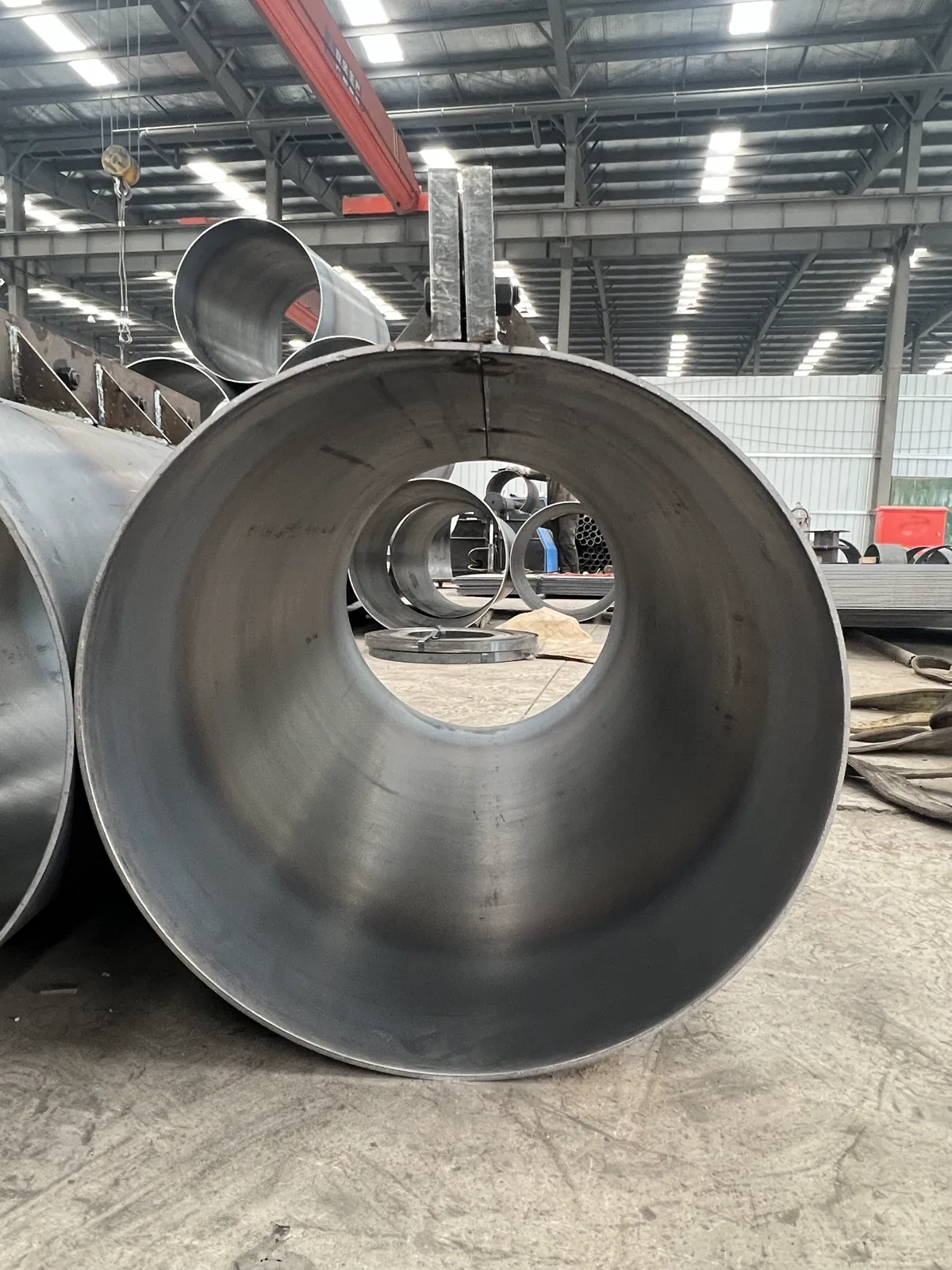
Common enquiries involve grades such as Q235B, Q355B, Q345R, NM400 and 45#. Availability, substitution, heat treatment, forming direction and welding suitability are reviewed against the specified standard; listed grades do not imply stock or automatic acceptance.
05 / PRODUCTION FLOW
From drawing review to dispatch preparation.
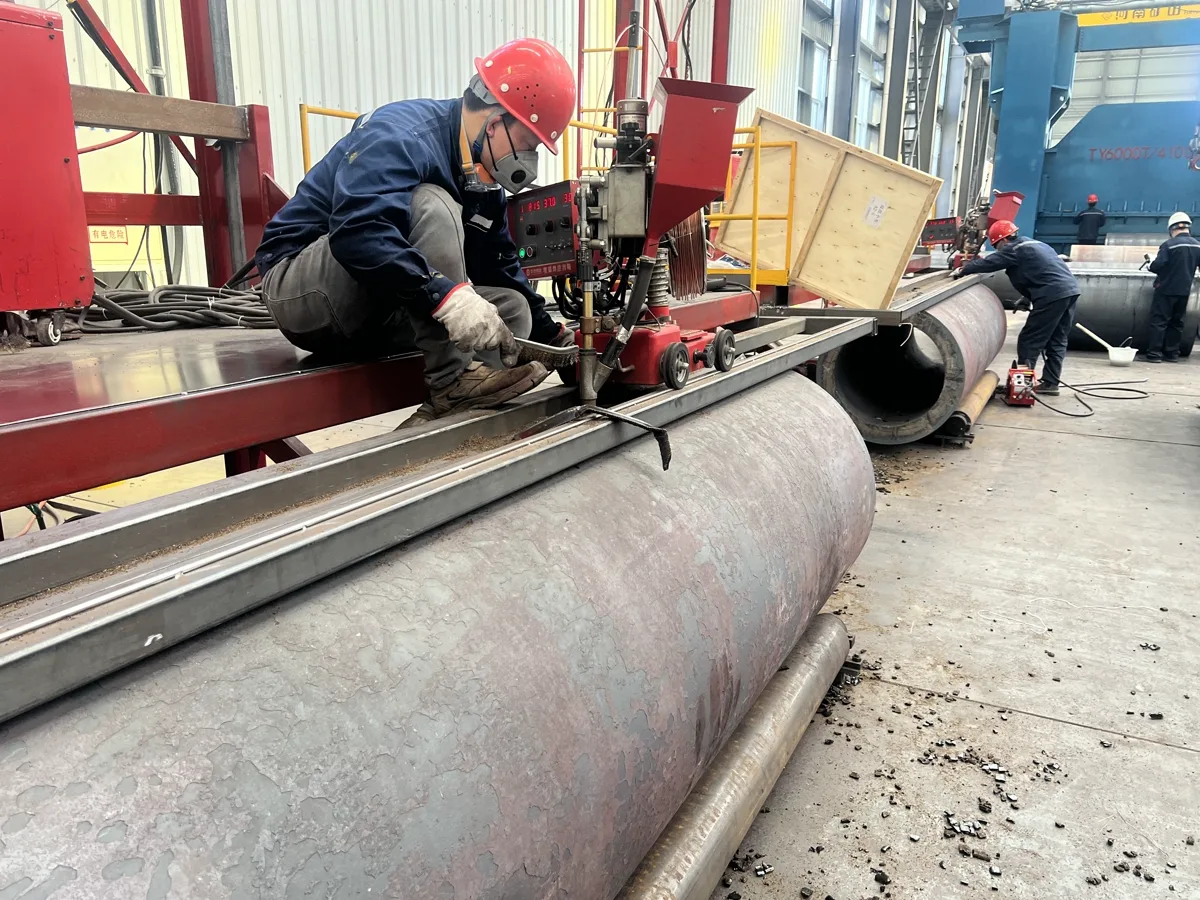
The exact route changes by project, but the control points remain clear: input review, process planning, production, agreed inspection, documentation and shipment preparation.
- 01
Input review
Drawing, material standard, dimensions, quantity, tolerance and delivery destination.
- 02
Process planning
Blank route, rolling sequence, seam layout, welding and inspection hold points.
- 03
Production
Cutting, forming, fit-up and agreed fabrication steps under the confirmed scope.
- 04
Inspection & dispatch
Agreed checks, document collation, surface protection, packing and loading preparation.
06 / QUALITY & DOCUMENTS
Agree the evidence package before production.
Order inputs
Approved drawings, material requirements, tolerances, weld details and inspection scope.
Material records
Material certificates, grade and heat references can be included when specified and available under the order scope.
Inspection records
Dimensional checks, visual inspection and NDT records are supplied only where agreed for the project.
Company credentials
Available Chinese enterprise-credit and supplier-registry records are business credentials, not ISO management-system certification.
No ISO certificate is claimed on this website. If an ISO or project-specific certificate is required, request a current, verifiable copy for the exact legal entity and scope.
07 / PACKING & SHIPPING
Packaging is planned around geometry and destination.
Before shipment, the parties confirm part identification, corrosion protection, support and restraint, lifting points, packing form and delivery terms. Oversized or heavy items require route and handling review; packing details are not assumed from a standard template.
Part marks and packing references matched to the agreed document set.
Surface and edge protection selected for the product and transport route.
Supports, lifting and loading arrangements reviewed for size and weight.
08 / RFQ CHECKLIST
Send enough information for a useful review.
A drawing is best. If it is not ready, send the known dimensions and operating context. We will identify missing items before quotation.
- Drawing or sketch with revision
- Material grade and governing standard
- Thickness, diameter, length and quantity
- Tolerances and edge / bevel requirements
- Welding, heat-treatment and NDT requirements
- Required records, packing and delivery destination
09 / TECHNICAL FAQ
Questions worth resolving before quotation.
These answers explain our review logic without replacing project-specific engineering confirmation.
Does the published maximum mean every grade can be rolled at that thickness?
No. Thickness, diameter, width, grade, required forming direction and equipment route interact. The upper range is a review boundary, not an automatic commitment.
Can cutting and rolling be quoted as one scope?
Yes, when requested, but they remain separate processes in the technical and commercial scope so inputs and acceptance criteria stay clear.
Which inspection documents are included?
Only the documents agreed before production. Material records, dimensional reports, visual inspection and NDT records must be specified in the enquiry and quotation.
Can you quote without a finished drawing?
We can perform an initial review from a sketch and known dimensions, but a reliable quotation requires enough geometry, material, quantity, tolerance and delivery information.
START WITH THE DRAWING
Tell us what must be made.
We will define what can be confirmed.
Email the drawing and specification, or use WhatsApp for an initial project discussion. Formal scope, price and delivery are confirmed only after technical review.